Module Three: Studio Lighting |
Characteristics of Light
There are four characteristics of light to be concerned with, Intensity, Diffusion, Direction and Type.
|

Back Lighting by Hanna L.
|
Light Intensity refers to how bright or dull the light is. |
Light Diffusion refers to how disturbed (separated) the light particles are when they reach the subject.
If the light particles are spread apart (diffused) when they hit the subject the shadows will be less defined. This is called soft lighting.
When there is nothing spreading the light particles apart before the light reaches the subject is it called direct or harsh lighting, this creates harsh well-defined shadows.
Objects that can diffuse light are clouds for natural light and shades for artificial light.
|

Diffused Light
|

Direct Light |
Perhaps most important of the characteristics is Light Direction. Front light, Cross-light and Back light give your photograph very different results. Front light, light that strikes the subject from the direction of the camera, flattens and minimizes value and texture. Cross-light is probably the most desirable because it successfully increases the visibility of the textures and helps the objects feel three dimensional. Back light is fun to use, but use it wisely. You lose all detail within the outer shape of your subject. Your subject is silhouetted and may have a halo around the edge.
|

Front light
|

Cross light
|

Cross light from 45 degrees relevant to the front of the subject
|

DO NOT USE FLASH
A flash floods the scene with light ruining the intentional light arrangement.
|
Second most important is Light Type, again, Natural, Existing and Artificial will all give you a vastly different look and mood to your photograph. Natural light is created by natural means, sun, moon and fire for example. It is unpredictable, unchangeable and possible inconsistent. In order to successfully use natural light you may have to move your subject and camera to get a good shot.
|
 |
Existing light is what already occurs in buildings and on streets. You can’t necessarily manipulate the streetlights or the lights in the school hallway. So with existing light you have to do what you can. This type of light is generally low which poses some additional obstacles.
Light provided by ladies restroom ceiling fixtures; image captured by Hannah E. |
Artificial light is what you would have in a studio setting. You can manipulate all the characteristics, intensity, diffusion and direction. Generally in a studio setting photographers are taking Portraits, photographs of people of animals, or a series of photographs of a Still Life, an arrangement of inanimate objects placed specifically for photographing.
|

Beautiful "studio" lighting by Jake G. |
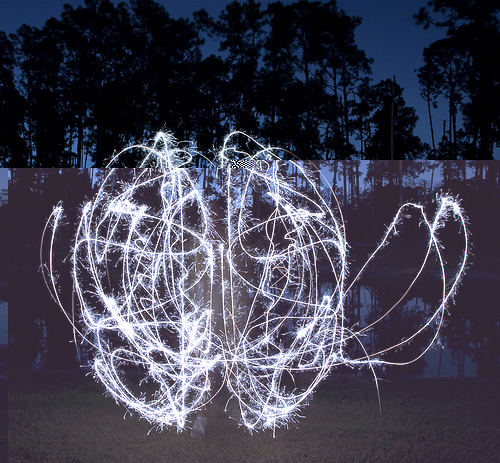
There are also unusual light sources that can create interesting photographs. Think outside the box on this one, but be safe!
|
   |
Tips
In many of these situations you will be required to use low light, use a tripod to avoid blurred pictures due to camera shake. I have a few tripods you can check out!
Module Three Assignments:
- Take a portrait or a self-portrait using studio lighting. (light bulbs in clip lamps serve our purpose:))
Upload it to FlickR with the Label "Portrait" and in the description explain how you know it is appropriate for the assignment and complete your Critique. (20 points)
- Take a still life shot using studio lighting. (light bulbs in clip lamps serve our purpose:))
Upload it to FlickR with the Label "Still Life " and in the description explain how you know it is appropriate for the assignment and complete your Critique. (20 points)
- Take a photograph that utilizes an “Unusual Light Source". Experiment with your camera's built in Modes to create an image you like. The light source may also be your subject.
Upload it to FlickR with the Label "Unusual Light Source" and in the description explain how you know it is appropriate for the assignment and complete your Critique. (20 points)
*Note* for the assignments above try using you camera setting that is specifically for low light situations. This may be "fireworks", "candlelight", or "campfire". Read the description for the modes or scenes your camera offers!
- Take a photograph that is considered "Candid" (photography of subjects acting naturally or spontaneously without being posed using natural or existing light).
Upload it to FlickR with the Label "Candid" and in the description explain how you know it is appropriate for the assignment and complete your Critique. (20 points)
|

